Headless CMS vs. Monolith: choosing the right architecture
A headless CMS is not an end in itself. The real question is whether editorial workflows, performance, integrations and maintainability benefit from it.
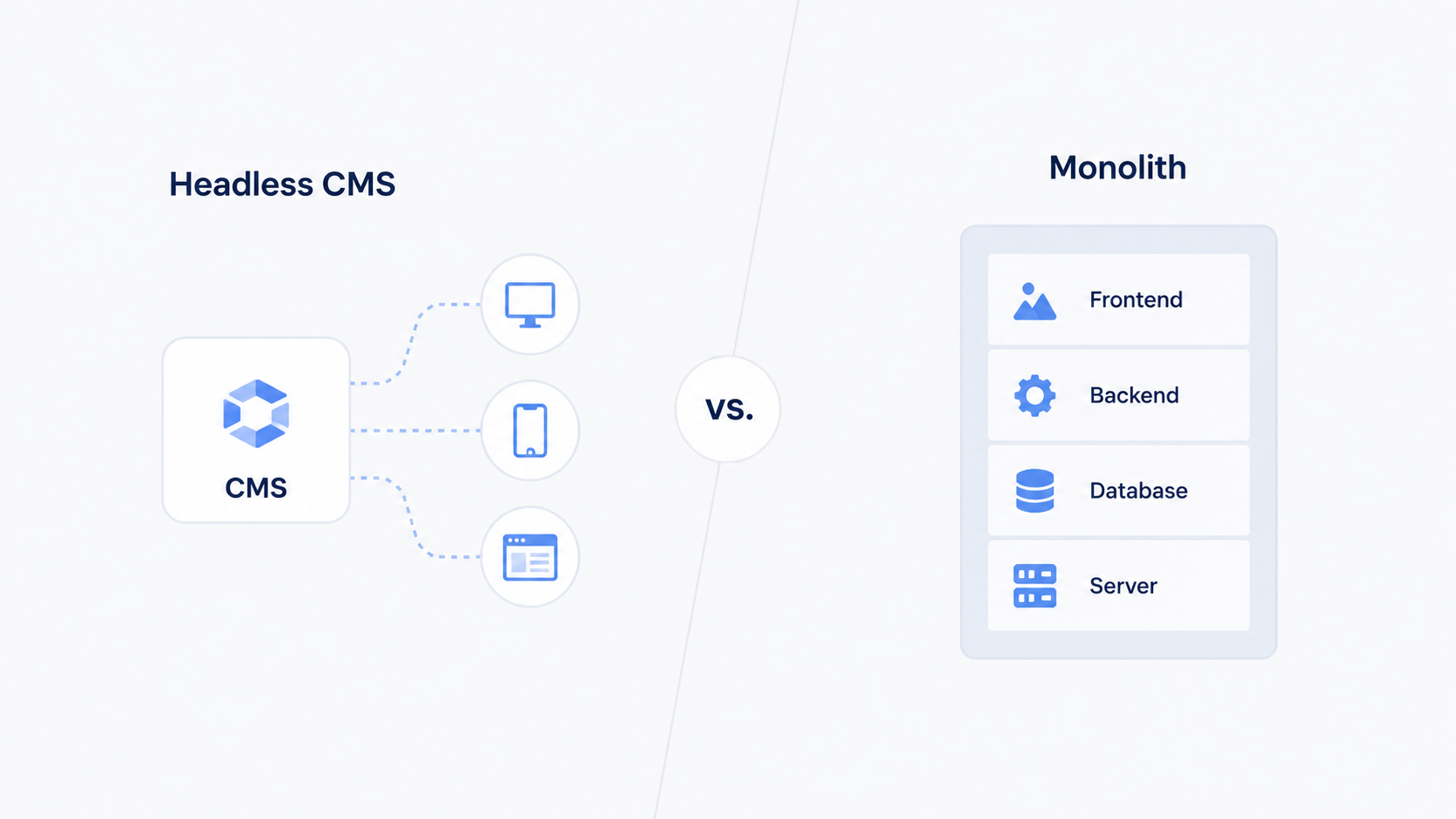
The question of headless CMS versus a classic monolith is often discussed too technically. In practice, the right choice depends on editorial workflows, frontend ambition, integrations and the operating model.
Headless makes sense when content serves more than one website
A decoupled CMS shows its strengths when content appears in several contexts: website, landing pages, app, product data, internal tools or automated campaigns. The frontend can stay flexible while editorial work and content modeling remain structured.
More freedom for frontend design and performance
Better reuse of content across multiple channels
Clearer data models for SEO, localization and integrations
A monolith still works when simplicity is the biggest lever
Not every project needs maximum flexibility. If a website is compact, has few integrations and depends on a familiar editorial model, a classic CMS can be faster and more economical.
Good CMS architecture does not start with technology. It starts with who needs to maintain which content, how often, and in which context.
Payload is strongest when editorial work and product development move closer together
Payload combines a modern developer experience with an editorial backend. Structured collections, rich text, media, SEO, preview and roles can be modeled in one system without limiting the frontend design.
The right path is rarely a generic either-or decision. For ambitious websites, a Payload-first setup is especially strong when content, translations, media and landing pages need to scale over time.